
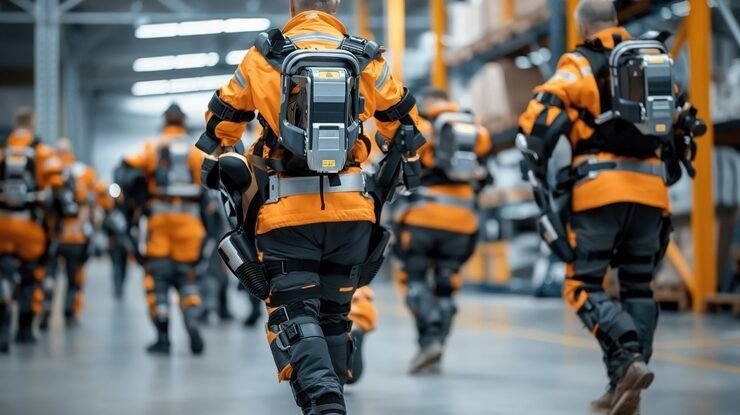
Industrial exoskeletons are wearable robotic systems designed to support human movement, reduce physical strain, and assist workers during demanding industrial activities. These systems combine mechanical structures, sensors, actuators, control technologies, and ergonomic design principles to enhance human capabilities in specific work environments.
Modern industrial exoskeletons are part of the broader field of wearable robotics technologies and human augmentation systems. They are being explored across manufacturing, construction, logistics, healthcare equipment production, aerospace, automotive assembly, and industrial maintenance applications. As industries continue adopting automation and advanced workplace technologies, exoskeleton systems represent a connection between human workers and robotic assistance.
Context
What Are Industrial Exoskeletons?
Industrial exoskeletons are wearable devices that attach to a person’s body to provide physical support during work activities. Unlike fully autonomous robots, exoskeletons operate together with human users by assisting natural movements rather than replacing human involvement.
These systems may support different parts of the body, including:
- Back support structures
- Shoulder assistance systems
- Arm-support devices
- Lower-body support systems
- Full-body wearable systems
The design depends on the type of physical activity and the environment where the system is used.
How Wearable Robotics Technologies Work
Wearable robotics technologies combine mechanical components and electronic systems to provide physical assistance.
The general operating process includes:
- Sensors detect body movement and user activity.
- Control systems analyze movement patterns.
- Mechanical or powered components provide assistance.
- The user continues controlling natural movement.
- Feedback systems adjust support according to activity conditions.
Some exoskeletons use passive mechanical support, while others use motors, batteries, and electronic control systems.
Types of Industrial Exoskeletons
Different industrial tasks require different exoskeleton designs.
| Exoskeleton Type | Primary Function | Typical Applications |
|---|---|---|
| Passive Exoskeleton | Uses springs or mechanical support | Manufacturing tasks |
| Powered Exoskeleton | Uses motors and control systems | Heavy industrial activities |
| Upper-Body Exoskeleton | Supports arms and shoulders | Overhead assembly work |
| Back-Support Exoskeleton | Reduces back strain | Material handling |
| Lower-Body Exoskeleton | Supports legs and posture | Industrial mobility tasks |
| Full-Body Exoskeleton | Provides broader physical assistance | Specialized applications |
Each type is designed according to workplace requirements and user movement patterns.
Main Components of Industrial Exoskeleton Systems
Industrial exoskeletons generally include:
- Frame structure
- Joints and mechanical links
- Sensors
- Actuators
- Batteries
- Control units
- Adjustment mechanisms
- User interface systems
These components work together to provide physical support and movement assistance.
Importance
Why Industrial Exoskeletons Matter
Many industrial activities involve repetitive movements, lifting tasks, overhead work, or physically demanding operations. Industrial exoskeletons are developed to support workers during specific tasks by reducing physical load and improving ergonomic conditions.
They are designed as assistance technologies that work alongside human operators.
Supporting Human Augmentation Systems
Human augmentation systems focus on improving human abilities through technology. Industrial exoskeletons represent one approach within this field by combining human movement with robotic assistance.
Applications include:
- Reducing physical workload
- Supporting repetitive tasks
- Improving ergonomic conditions
- Assisting industrial assembly activities
- Supporting precision operations
- Helping workers maintain specific postures
The effectiveness of these systems depends on task requirements, workplace conditions, and proper usage.
Industrial Applications
Industrial exoskeletons are being explored across multiple sectors.
Automotive Manufacturing: Exoskeleton systems may support workers performing overhead assembly tasks, component installation, and repetitive production activities.
Aerospace Manufacturing: Aircraft assembly involves tasks requiring extended arm positions and precision work, where wearable support systems may assist operators.
Construction Industry: Exoskeleton technologies are being studied for activities involving material handling, tool usage, and physically demanding operations.
Warehousing and Logistics: Some systems are designed to support lifting activities and repetitive material movement.
Industrial Maintenance: Maintenance personnel may use wearable robotic systems during equipment inspection, repair, and servicing activities.
Benefits of Wearable Robotics Technologies
Industrial exoskeleton systems provide several potential advantages.
These include:
- Improved ergonomic support
- Assistance during repetitive activities
- Reduced physical effort in specific tasks
- Support for industrial mobility
- Integration with workplace technologies
- Human-machine collaboration
Results depend on equipment design, task suitability, workplace environment, and user training.
Recent Updates
Growth of Human-Robot Collaboration
Between 2024 and 2026, industrial exoskeleton development has increasingly focused on collaboration between humans and robotic systems. Instead of replacing workers, many wearable robotics technologies are designed to provide targeted physical assistance.
Artificial Intelligence Integration
Artificial intelligence is increasingly being explored in wearable robotics systems to analyze movement patterns and improve assistance control.
AI-based technologies may support:
- Motion recognition
- User movement analysis
- Adaptive assistance
- System performance monitoring
Human users remain responsible for operational control.
Lightweight Materials Development
Manufacturers continue developing lighter and more flexible exoskeleton structures using advanced materials such as lightweight alloys, composites, and improved mechanical designs.
These developments aim to improve comfort and usability.
Sensor and Control Improvements
Modern industrial exoskeletons increasingly use advanced sensors to monitor:
- Body movement
- Joint position
- Force levels
- User activity
- System performance
Improved sensors allow more responsive assistance.
Integration with Smart Manufacturing
Industrial exoskeletons are increasingly studied alongside:
- Industrial IoT platforms
- Smart factory systems
- Digital workplace technologies
- Worker assistance platforms
- Industrial automation networks
These connections support future human-machine collaboration environments.
Laws or Policies
Workplace Safety Regulations
Industrial exoskeleton usage is generally considered within existing workplace safety frameworks covering equipment operation, worker protection, ergonomic practices, and risk assessment.
Organizations evaluate whether wearable systems are appropriate for specific tasks.
Ergonomic Guidelines
Workplace ergonomics guidelines address factors such as:
- Physical workload
- Repetitive movement
- Body posture
- Workstation design
- Manual handling activities
Exoskeleton systems may be evaluated as part of broader ergonomic approaches.
Equipment Safety Standards
Wearable robotic systems may follow technical standards related to:
- Mechanical safety
- Electrical systems
- Battery protection
- Human-machine interaction
- Equipment reliability
Specific requirements depend on application and location.
Data and Privacy Considerations
Some advanced exoskeleton systems collect movement-related information through sensors. Organizations generally consider data management practices when implementing connected wearable technologies.
Tools and Resources
Digital Human Modeling Software
Engineering software helps analyze:
- Human movement
- Workplace ergonomics
- Physical workload
- Equipment interaction
- Workspace design
These tools support evaluation before implementation.
Motion Analysis Systems
Motion capture technologies measure:
- Body movement
- Joint positions
- Force patterns
- User interaction
These systems are used in research and industrial ergonomics studies.
Industrial Simulation Platforms
Simulation tools evaluate:
- Worker movements
- Production processes
- Equipment integration
- Workplace layouts
These platforms support industrial planning.
Wearable Technology Monitoring Platforms
Digital platforms can collect information related to:
- System operation
- Battery condition
- Equipment status
- Usage patterns
These tools support equipment management.
Educational Resources
People interested in industrial exoskeletons and wearable robotics technologies can learn from:
- Robotics engineering organizations
- Human factors research publications
- Industrial automation resources
- Ergonomics studies
- Manufacturing technology publications
- Technical education platforms
These resources explain wearable robotics, human augmentation systems, and industrial applications.
FAQs
What is an industrial exoskeleton?
An industrial exoskeleton is a wearable robotic system designed to provide physical support and assistance during specific industrial activities.
How do wearable robotics technologies work?
Wearable robotics technologies use sensors, mechanical structures, actuators, and control systems to assist human movement while allowing users to maintain control.
Where are industrial exoskeletons used?
Industrial exoskeletons are used in manufacturing, automotive production, aerospace assembly, construction, logistics, maintenance, and other industrial environments.
What are human augmentation systems?
Human augmentation systems are technologies designed to enhance human abilities through mechanical, digital, or robotic assistance.
Are industrial exoskeletons replacing industrial robots?
Industrial exoskeletons are generally designed to support human workers rather than replace industrial robots. They focus on human-machine collaboration and task assistance.
Conclusion
Industrial exoskeletons represent an emerging area of wearable robotics technologies that combine human movement with robotic assistance. Through advanced sensors, mechanical systems, and human augmentation approaches, these technologies support specific industrial tasks and workplace ergonomics. As smart manufacturing and human-machine collaboration continue developing, industrial exoskeletons remain an important area of innovation in modern industrial applications.