Industrial robotic arms are programmable mechanical systems designed to perform automated movement, handling, assembly, processing, inspection, and manufacturing tasks. They combine mechanical structures, motors, gear systems, sensors, controllers, and software to move tools or workpieces along programmed paths.
Robotic arms are widely used in automotive manufacturing, electronics, metal fabrication, packaging, food processing, pharmaceuticals, logistics, and general industrial production. Different robot architectures provide different combinations of reach, payload, speed, precision, flexibility, and degrees of freedom.
Context
What Are Industrial Robotic Arms?
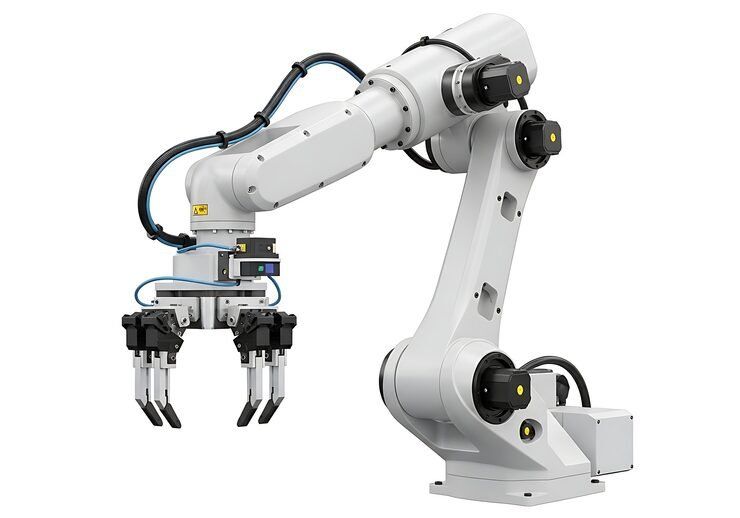
An industrial robotic arm is a programmable manipulator with interconnected joints and links that allow controlled movement. The arm can position an end effector such as a gripper, welding torch, cutting tool, dispensing head, or inspection device.
A typical robotic system includes the robot arm, controller, teach pendant, motors, transmission components, sensors, end effector, and safety equipment.
The robot controller coordinates the movement of individual joints according to programmed instructions. Sensors can provide information about position, force, speed, or environmental conditions.
Major Industrial Robot Types
Industrial robotic arms are available in several mechanical configurations.
| Robot Type | Motion Characteristics | Common Applications |
|---|---|---|
| Articulated Robot | Multiple rotary joints | Welding, assembly, handling |
| SCARA Robot | Fast horizontal-plane movement | Electronics, assembly |
| Cartesian Robot | Linear X-Y-Z movement | Machining and material handling |
| Delta Robot | Parallel high-speed motion | Packaging and picking |
| Cylindrical Robot | Rotary and linear movement | Handling and assembly |
| Polar Robot | Spherical work envelope | Handling and processing |
| Collaborative Robot | Human-oriented operation | Assembly and inspection |
| Gantry Robot | Large Cartesian movement | Heavy handling |
The appropriate architecture depends on workspace, payload, reach, speed, accuracy, environmental conditions, and application requirements.
Articulated Robotic Arms
Articulated robots use rotary joints arranged similarly to a human arm. Six-axis articulated robots are particularly common because they can provide flexible positioning and orientation.
They can move around obstacles and position tools at different angles, making them suitable for welding, painting, assembly, machine tending, material handling, and many other applications.
SCARA Robots
SCARA stands for Selective Compliance Assembly Robot Arm. These systems typically provide fast horizontal movement while maintaining controlled vertical positioning.
SCARA robots are frequently used for assembly, component insertion, packaging, electronic manufacturing, and high-speed pick-and-place tasks.
Cartesian Robots
Cartesian robots use linear axes arranged along perpendicular directions. Their movement is generally described using X, Y, and Z coordinates.
They are often used for material handling, dispensing, machining, palletizing, and applications requiring relatively straightforward linear movement.
Delta Robots
Delta robots use parallel link mechanisms connected to a common moving platform. Their lightweight arms can achieve rapid movement.
They are particularly relevant to high-speed picking, sorting, packaging, and food-processing applications.
Importance
Why Industrial Robotic Arms Matter
Industrial robotic arms can perform repetitive or highly controlled movements with consistent programmed sequences. They are particularly useful for tasks requiring repeated positioning, handling, joining, coating, inspection, or material transfer.
Robots can also operate in environments involving heat, fumes, hazardous materials, sharp objects, or other conditions where direct human involvement may be restricted.
Degrees of Freedom
A robot's degrees of freedom determine how independently it can position and orient its end effector.
A six-axis articulated robot can generally control three-dimensional position along with three orientation movements. Other robot architectures may provide fewer or more specialized movement configurations.
Payload and Reach
Payload describes the load that the robot can carry while maintaining specified performance. Reach describes the distance over which the robot can position its end effector.
Payload calculations should consider the complete end-of-arm tooling assembly, workpiece, inertia, mounting configuration, and motion profile.
Robot Accuracy and Repeatability
Accuracy describes how closely the robot reaches a commanded position, while repeatability describes its ability to return to a position consistently.
Industrial applications often emphasize repeatability because many automated processes involve repeated movement between known positions.
End-of-Arm Tooling
The end effector is the equipment attached to the robot wrist. It determines what physical task the robot can perform.
Common end-effector categories include:
Mechanical grippers
Vacuum grippers
Welding tools
Cutting tools
Dispensing heads
Screwdriving tools
Polishing tools
Inspection cameras
The end effector must be matched with the robot's payload, interface, utilities, and operating environment.
Automation Technologies
Servo Motor Systems
Industrial robots commonly use servo motors to control joint movement. Servo drives receive commands from the robot controller and regulate motor position, speed, and torque.
Encoder feedback provides information about motor or joint position, allowing closed-loop control.
Gear Reduction Systems
Robot joints often use gear-reduction mechanisms to increase torque and control movement.
Common transmission technologies include harmonic drives, planetary gear systems, cycloidal reducers, and other precision mechanisms.
Machine Vision
Machine-vision systems allow robots to identify objects, inspect components, locate workpieces, and adapt movement based on visual information.
Cameras can be integrated with robot controllers or separate vision systems depending on the application.
Force and Torque Sensing
Force and torque sensors can detect physical interaction between the robot and its environment.
These sensors are useful in assembly, insertion, polishing, surface finishing, and other applications where controlled contact force is important.
Artificial Intelligence
AI technologies are increasingly being explored for robot perception, object recognition, path planning, anomaly detection, and process optimization.
AI can complement conventional robot programming, although safety-critical movement and machine behavior still require appropriate engineering controls.
Industrial Communication
Robotic systems can communicate with programmable logic controllers, manufacturing execution systems, sensors, vision systems, and other factory equipment.
Industrial communication protocols allow robots to exchange production and machine-status information within automated environments.
Manufacturing Processes
Robot Structure Manufacturing
Robot arms are commonly constructed from engineered metals and precision-machined components. Links, housings, mounting structures, and joint assemblies require controlled dimensions and rigidity.
Casting, forging, welding, CNC machining, heat treatment, and surface finishing can be used depending on component design.
Joint Manufacturing
Robot joints contain motors, reducers, bearings, encoders, seals, and mechanical structures.
Precision machining is important because small dimensional errors can influence joint movement and overall robot accuracy.
Gear and Reducer Manufacturing
Gear systems require carefully controlled tooth geometry, hardness, surface finish, and dimensional accuracy.
Specialized reduction systems such as harmonic and cycloidal drives require precision manufacturing and assembly.
Controller Manufacturing
Robot controllers contain processors, power electronics, communication interfaces, safety circuits, and software.
The controller coordinates movement across multiple joints and manages communication between the robot, sensors, tooling, and production equipment.
Assembly and Calibration
After mechanical and electrical assembly, robots undergo calibration and functional testing.
Testing can include joint movement, encoder feedback, payload evaluation, positional accuracy, repeatability, communication, safety functions, and application-specific motion tests.
Industrial Applications
Automotive Manufacturing
Automotive plants use robotic arms for welding, painting, assembly, material handling, inspection, and machine tending.
Robotic welding is particularly common because robots can follow programmed paths repeatedly while maintaining controlled tool orientation.
Electronics Manufacturing
Electronics production often requires precise handling and assembly of small components.
SCARA, Cartesian, delta, and collaborative robots can be used for component placement, inspection, dispensing, screwdriving, and material transfer.
Metal Fabrication
Robotic arms can perform welding, cutting, grinding, polishing, deburring, and material handling.
Robotic systems can maintain programmed tool paths and process parameters across repeated production cycles.
Packaging
Packaging operations can use delta and articulated robots for picking, sorting, packing, palletizing, and product handling.
Machine vision can help robots identify products and adjust their movement according to product position.
Pharmaceutical Manufacturing
Robots can be used for controlled material handling, packaging, laboratory automation, inspection, and selected manufacturing operations.
Special environmental requirements may apply to robots operating in controlled production areas.
Food Processing
Robotic arms can handle, sort, pack, palletize, and inspect food products. Equipment design may need to account for hygiene, washdown, temperature, and material compatibility.
Logistics and Warehousing
Robotic arms can be integrated with conveyors, automated storage systems, autonomous mobile robots, and machine-vision systems.
Applications include sorting, picking, palletizing, depalletizing, and parcel handling.
Recent Updates
Collaborative Robots
Collaborative robots are designed to work in applications where people and robotic systems may operate in close proximity under defined safety conditions.
Their deployment requires risk assessment, appropriate safeguards, speed and force limitations, and application-specific safety measures.
Mobile Manipulation
Robotic arms can increasingly be mounted on autonomous mobile platforms.
This combination allows manipulation equipment to move between work areas rather than remaining permanently installed at one workstation.
Digital Twins
Digital twin technologies can create virtual representations of robotic systems and production cells.
Simulation can be used for robot programming, reach analysis, cycle evaluation, collision checking, and production planning before physical deployment.
AI-Based Vision
Advances in computer vision and machine learning are helping robots recognize variable objects and adapt to less structured environments.
These capabilities are particularly relevant to picking, sorting, inspection, and material-handling applications.
Predictive Maintenance
Robot controllers and connected sensors can collect information about joint temperature, motor load, vibration, operating cycles, and other parameters.
Analyzing this information can help identify unusual operating patterns and support maintenance planning.
Laws or Policies
Industrial Robot Safety
Industrial robotic systems require appropriate risk assessment, guarding, emergency controls, safety-rated monitoring, and defined operating procedures.
Safety requirements vary according to robot type, application, installation environment, and jurisdiction.
Collaborative Robot Safety
Collaborative applications require additional consideration of human-robot interaction, speed, force, workspace, tooling, workpiece characteristics, and foreseeable contact conditions.
A collaborative robot does not automatically make an entire application safe. The complete work cell must be evaluated.
Electrical Safety
Robotic systems contain motors, drives, controllers, power supplies, sensors, and communication equipment. Electrical installation and maintenance should follow applicable requirements.
Machine Integration
Robots integrated into production lines should be evaluated together with conveyors, fixtures, tooling, sensors, and other machinery. The complete cell determines the overall safety requirements.
Tools and Resources
Industrial robotic systems use programming software, teach pendants, simulation platforms, robot controllers, vision systems, calibration equipment, force sensors, and industrial communication interfaces.
Robot simulation software can help engineers evaluate reach, joint movement, cycle time, collision risks, and workstation layouts before physical installation.
Maintenance teams may use diagnostic software, vibration monitoring, motor-current analysis, encoder data, and manufacturer documentation to evaluate robot condition.
FAQs
What are industrial robotic arms?
Industrial robotic arms are programmable mechanical manipulators used to automate movement, handling, assembly, processing, inspection, and manufacturing activities.
What are the main types of industrial robots?
Major types include articulated, SCARA, Cartesian, delta, cylindrical, polar, collaborative, and gantry robots.
What is an articulated robotic arm?
An articulated robotic arm uses multiple rotary joints to provide flexible movement and positioning. Six-axis configurations are widely used for welding, assembly, handling, painting, and machine tending.
How are industrial robotic arms controlled?
Robotic arms are controlled through dedicated controllers that coordinate servo motors, encoders, motion programs, sensors, and communication systems.
Where are industrial robotic arms used?
They are used in automotive manufacturing, electronics, metal fabrication, packaging, pharmaceuticals, food processing, logistics, machine tending, inspection, and many other industrial environments.
Conclusion
Industrial robotic arms are programmable automation systems that combine mechanical structures, servo drives, precision transmissions, sensors, controllers, software, and end-of-arm tooling. Different architectures, including articulated, SCARA, Cartesian, delta, collaborative, and gantry robots, address different movement and production requirements.
Modern robotic systems increasingly incorporate machine vision, force sensing, industrial communication, digital twins, AI-based perception, and condition monitoring. These technologies allow robots to participate in increasingly complex manufacturing and material-handling processes.
Successful robot integration depends on application requirements such as payload, reach, speed, repeatability, workspace, tooling, environmental conditions, and production objectives. Safety engineering, system calibration, maintenance, and appropriate operator procedures are also essential parts of an industrial robotic installation.