
Precision bearing manufacturing is the process of producing mechanical components that support rotating or moving parts while controlling friction, alignment, and movement. Bearings are essential in machinery because they help shafts, wheels, motors, turbines, and other components operate with controlled motion. Precision bearings are manufactured to meet defined requirements for dimensional accuracy, surface finish, load capacity, and rotational performance.
These components are used in automotive systems, industrial machinery, aerospace equipment, medical devices, robotics, and power generation. Their design and manufacturing quality can influence equipment vibration, noise, operating temperature, energy use, and service life.
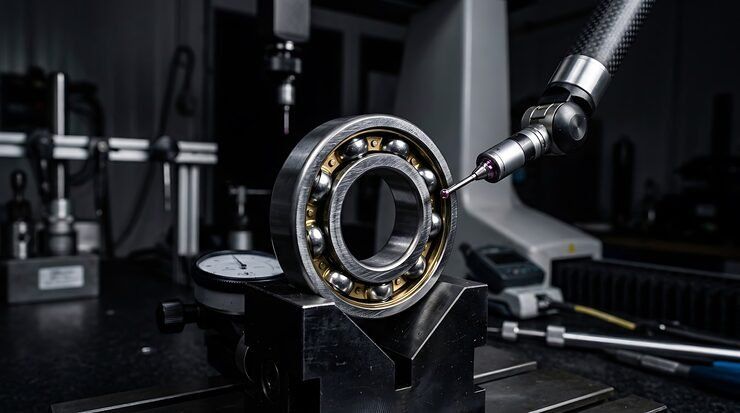
Precision engineering plays a central role in bearing production because small variations in dimensions, geometry, or surface condition can affect how bearing components interact. Manufacturers therefore use specialized machining, heat treatment, grinding, inspection, and assembly processes to achieve the required specifications.
What is a precision bearing?
A precision bearing is a mechanical component manufactured to specified tolerances for applications that require controlled rotation, alignment, or movement. Depending on its design, a bearing may support radial loads, axial loads, or a combination of both.
A typical rolling-element bearing contains several main components:
Inner ring: Fits around a shaft and provides a raceway for the rolling elements.
Outer ring: Fits within a housing and provides the outer raceway.
Rolling elements: Balls or rollers that transmit loads between the rings.
Cage or retainer: Maintains the spacing and positioning of the rolling elements.
Seals or shields: Used in selected designs to limit contamination or retain lubricant.
Not every bearing contains all these components. Plain bearings, for example, support movement through sliding contact rather than rolling elements.
Why precision matters
Bearing precision is determined by factors such as dimensional tolerances, roundness, raceway geometry, surface roughness, internal clearance, and runout. The relevant requirements depend on the bearing type and its intended operating conditions.
In high-speed machine tools, a bearing may require controlled runout and low vibration. In heavy industrial equipment, load capacity and resistance to operating stresses may be more important. Bearings used in medical instruments or specialized measurement equipment may require particular combinations of smooth movement, compact dimensions, and controlled positioning.
Precision does not refer to one universal specification. It describes the degree to which a bearing meets the dimensional and performance requirements defined for its application.
Main Types of Precision Bearings
Bearing designs differ according to their rolling elements, contact geometry, load direction, and operating requirements. Selecting the correct type involves considering speed, load, alignment, lubrication, temperature, and installation conditions.
Ball bearings
Ball bearings use spherical rolling elements between inner and outer raceways. Their design can reduce friction and support rotational movement across many types of machinery.
Common variations include deep-groove ball bearings, angular-contact ball bearings, and thrust ball bearings. Deep-groove designs are widely used in electric motors and general machinery, while angular-contact designs can accommodate combined radial and axial loads under appropriate conditions.
Roller bearings
Roller bearings use cylindrical, tapered, spherical, or needle-shaped rolling elements. The contact geometry distributes loads differently from ball bearings, making roller designs suitable for various demanding applications.
Cylindrical roller bearings: Common in applications requiring substantial radial load capacity.
Tapered roller bearings: Designed to accommodate combined radial and axial loads.
Spherical roller bearings: Can accommodate certain alignment variations while carrying substantial loads.
Needle roller bearings: Use long, slender rollers for applications with limited radial space.
Thrust bearings
Thrust bearings are designed primarily to support axial loads acting along a shaft. Depending on their construction, they may use balls, cylindrical rollers, or other rolling elements.
They are found in gear systems, industrial machinery, vehicle assemblies, and equipment where forces act parallel to the shaft's axis.
Plain bearings and specialized bearings
Plain bearings support motion through sliding surfaces, often with a lubricating film or a low-friction material. They are used in engines, pumps, heavy machinery, and applications where their structural simplicity or load characteristics are appropriate.
Specialized precision bearings include spindle bearings, crossed-roller bearings, miniature bearings, and thin-section bearings. These designs support applications such as machine tools, robotic joints, optical equipment, and compact mechanical assemblies.
Precision Bearing Manufacturing Processes
Manufacturing a precision bearing involves several interconnected stages. Each stage contributes to the dimensions, material properties, surface quality, and operating behavior of the finished component.
Material selection and preparation
Bearing rings and rolling elements are commonly produced from steels selected for hardness, fatigue resistance, cleanliness, and dimensional stability. Depending on the application, manufacturers may also use stainless steels, ceramic materials, or specialized alloys.
Material selection depends on operating loads, rotational speed, corrosion exposure, temperature, lubrication, and required performance characteristics. Incoming materials are inspected to confirm that they meet the relevant chemical and physical specifications.
Forging and forming
Steel rings may begin as billets, bars, or other prepared stock. Forging and forming processes shape the material into components that can subsequently be machined.
These operations can help establish the basic geometry of a ring while managing material structure and production efficiency. The exact process depends on bearing size, design, material, and manufacturing volume.
Turning and machining
Machining establishes the initial dimensions of bearing rings and other components. Turning operations create the main ring geometry, while drilling, cutting, and other processes may be used where the design requires them.
Dimensional control is important because later operations depend on consistent machining allowances. Poorly controlled geometry can increase finishing requirements or cause a component to fall outside the specified tolerances.
Heat treatment
Heat treatment changes the material's microstructure and mechanical properties. Bearing components may undergo hardening and tempering processes to achieve the required hardness and resistance to contact fatigue.
Heat treatment must be carefully controlled because temperature variation, distortion, and residual stresses can influence the component's final dimensions and performance. Some components require additional stabilization or finishing operations after heat treatment.
Grinding and superfinishing
Grinding removes small amounts of material to achieve precise dimensions and raceway geometry. It is a critical stage in producing many precision bearing rings and rolling elements.
Superfinishing further improves selected surface characteristics by removing very small irregularities. Surface quality influences friction, lubricant film behavior, vibration, and contact conditions during operation.
Assembly and lubrication
Finished rings and rolling elements are inspected before assembly. Components are matched according to the design requirements, and the cage, seals, or shields are installed where applicable.
Lubricants may be added during assembly or specified for application after installation. The correct lubricant depends on speed, load, temperature, contamination exposure, and operating environment.
Inspection and quality control
Precision bearings undergo dimensional and functional checks at relevant production stages. Inspection may include measurements of bore diameter, outside diameter, raceway geometry, clearance, runout, surface roughness, and vibration.
Depending on the bearing and its intended use, manufacturers may also conduct hardness testing, metallurgical examination, material analysis, and performance testing. Documented inspection procedures help verify conformity with the applicable product specification.
Importance of Precision Bearings in Modern Industry
Precision bearings are important because they help machinery maintain controlled movement under different operating conditions. Their performance affects equipment reliability, positioning accuracy, noise, vibration, and maintenance requirements.
Industrial applications
Automotive manufacturing: Bearings are used in transmissions, wheel hubs, electric motors, steering systems, and other vehicle assemblies. Different designs are selected according to rotational speed, load, temperature, and packaging constraints.
Aerospace equipment: Aircraft engines, auxiliary systems, actuators, and other specialized assemblies use bearings designed for defined operating environments. Material properties, traceability, and strict inspection procedures are important in these applications.
Industrial automation and robotics: Bearings support robot joints, rotary tables, servo motors, and automated production equipment. Low friction, controlled movement, and suitable stiffness can contribute to positioning accuracy.
Machine tools: Precision spindle bearings support rotating tools and workpieces. Their geometry, preload, lubrication, and thermal behavior influence spindle performance and machining accuracy.
Energy production: Bearings are used in turbines, generators, wind turbines, pumps, and related rotating equipment. Requirements vary with shaft speed, loading, temperature, and environmental exposure.
Medical and laboratory equipment: Compact bearings can support imaging systems, laboratory instruments, diagnostic equipment, and other devices requiring controlled movement. Material compatibility and operating cleanliness may be important depending on the application.
Factors that influence bearing performance
Several conditions determine how a bearing performs during operation:
Load and speed: Excessive loading or unsuitable rotational speeds can increase heat generation and fatigue.
Lubrication: Incorrect lubricant selection or insufficient lubrication can increase friction and wear.
Alignment: Misalignment can create uneven loading and reduce operating reliability.
Contamination: Dust, moisture, and foreign particles can damage raceways and rolling elements.
Temperature: Thermal expansion can change internal clearance and affect lubricant behavior.
Installation: Incorrect mounting, excessive force, or unsuitable fits can damage bearing components.
Even a precisely manufactured bearing can perform poorly if it is incorrectly installed or operated outside its specified conditions.
Recent Developments in Precision Bearing Technology
Precision bearing manufacturing continues to evolve through improvements in materials, production automation, metrology, lubrication, and condition monitoring. Recent industry developments through 2024–2026 reflect growing interest in higher rotational speeds, compact machinery, electrification, and predictive maintenance.
Advanced materials and manufacturing methods
Bearing manufacturers continue to develop and refine specialized steels, ceramic rolling elements, coatings, and surface treatments for particular operating environments. Ceramic materials, including silicon nitride, are used in selected hybrid bearings, where ceramic rolling elements operate with steel rings.
Hybrid bearing designs can provide advantages in certain high-speed or electrically demanding applications. However, their suitability depends on load conditions, lubrication, operating temperature, and system design.
Grinding equipment, automated handling, and advanced measurement systems also support tighter process control. Digital inspection can help identify dimensional variation and detect recurring manufacturing problems across production batches.
Automation and digital manufacturing
Modern bearing plants may use automated production lines, machine monitoring, statistical process control, and digital production records. These systems help manufacturers track process conditions and maintain consistency across multiple production stages.
Computer-controlled grinding and automated inspection can reduce some sources of variation, although equipment calibration, tooling condition, and operator procedures remain important. Digital systems also make it easier to connect production records with material batches and inspection results.
Smart bearings and predictive maintenance
Some bearing systems incorporate sensors or work alongside external monitoring equipment to measure vibration, temperature, speed, or other operating conditions. This information can help maintenance teams identify unusual behavior before a fault becomes severe.
Predictive maintenance systems analyze trends in operating data to identify possible lubrication problems, imbalance, misalignment, or bearing deterioration. Their usefulness depends on sensor placement, data quality, operating conditions, and appropriate interpretation.
Bearings for electrification and renewable energy
Electric motors, wind turbines, and other electrified systems create specific bearing requirements. Electrical current passing through a bearing can cause surface damage in some applications, while high speeds and changing loads can influence lubrication and temperature.
Manufacturers address these conditions through application-specific designs, electrical insulation, conductive components, suitable lubricants, and monitoring strategies where appropriate. No single design is suitable for every electric motor or renewable energy system.
Standards, Regulations, and Quality Requirements
Precision bearing manufacturing is influenced by dimensional standards, material specifications, quality management systems, and industry-specific requirements. The exact obligations depend on the bearing type, application, customer specification, and country of manufacture or use.
Common international standards
Several standards organizations publish documents relevant to bearing dimensions, tolerances, testing, and quality management.
ISO 15: Specifies boundary dimensions for certain radial rolling bearings.
ISO 492: Covers dimensional and geometrical tolerances for radial rolling bearings.
ISO 281: Addresses dynamic load ratings and rating life calculations for rolling bearings.
ISO 9001: Defines requirements for quality management systems.
ISO 14001: Provides a framework for environmental management systems.
These standards address different aspects of bearing production and use. A manufacturer's compliance with a quality management standard does not, by itself, demonstrate that every bearing meets every application-specific requirement.
Requirements in India
Manufacturers and users in India may need to consider applicable Bureau of Indian Standards requirements, industrial safety rules, environmental regulations, and customer-specific specifications. Whether a particular bearing must comply with a specific Indian Standard or mandatory certification requirement depends on the product category and current regulations.
Bearings used in safety-critical or regulated equipment may also be subject to additional technical, documentation, and traceability requirements. Manufacturers generally need appropriate inspection records and quality procedures to demonstrate conformity with the applicable specifications.
Testing and quality assurance
Quality assurance may include material certification, dimensional inspection, hardness testing, surface roughness measurement, vibration testing, and verification of internal clearance. Specialized applications may require fatigue testing, cleanliness assessments, or additional metallurgical examination.
Calibration of measurement instruments is also important. Reliable measurements help manufacturers distinguish actual component variation from errors caused by unsuitable inspection equipment or procedures.
Tools and Resources for Precision Bearing Manufacturing
Manufacturers use engineering software, measurement instruments, testing equipment, and technical documentation to support bearing design and production.
Common engineering and inspection tools
Computer-aided design (CAD): Used to develop bearing geometry, component dimensions, and assembly arrangements.
Finite element analysis (FEA): Helps engineers study stresses, deformation, and load distribution under defined conditions.
Coordinate measuring machines (CMMs): Measure component dimensions and geometric characteristics to verify compliance with engineering specifications.
Surface roughness testers: Measure surface texture on raceways and other precision-machined surfaces.
Vibration analysis equipment: Measures vibration patterns that can indicate changes in bearing condition or rotating machinery performance.
Hardness testing machines: Check whether heat-treated bearing components meet specified hardness requirements.
Bearing calculation software: Supports calculations involving load ratings, operating life, fits, internal clearance, and other design considerations.
Major manufacturers and industry participants
The international bearing industry includes specialized manufacturers serving automotive, aerospace, industrial machinery, energy, and precision engineering markets. Companies operating in this sector include SKF, Schaeffler, NSK, NTN, JTEKT, Timken, and MinebeaMitsumi.
Their product ranges differ by bearing type, application, manufacturing capability, and regional availability. Selecting a bearing requires comparing technical specifications and application requirements rather than relying on brand recognition alone.
Factors to consider when specifying a precision bearing
Factor | Technical purpose |
|---|---|
Bearing type | Matches the required load direction and movement |
Dimensional tolerance | Defines acceptable dimensional variation |
Load rating | Indicates the bearing's capacity under specified conditions |
Operating speed | Establishes suitable rotational limits |
Lubrication | Supports appropriate friction and wear behavior |
Material | Determines relevant mechanical and environmental properties |
Sealing arrangement | Helps control lubricant retention and contamination |
Inspection requirements | Establishes the checks needed to verify conformity |
These factors work together. A bearing selected for a high-speed spindle, for example, may require different characteristics from a bearing designed for a heavily loaded conveyor.
Frequently Asked Questions
What is precision bearing manufacturing?
Precision bearing manufacturing involves producing bearings to specified dimensional, geometric, and performance requirements. It commonly includes material preparation, machining, heat treatment, grinding, finishing, assembly, and quality inspection.
What materials are used to manufacture precision bearings?
Common materials include bearing steel, stainless steel, ceramic materials, and selected specialized alloys. The choice depends on load, speed, temperature, corrosion exposure, lubrication, and the intended operating environment.
What is the difference between ball bearings and roller bearings?
Ball bearings use spherical rolling elements, while roller bearings use cylindrical, tapered, spherical, or needle-shaped elements. Their contact geometry influences load capacity, friction, alignment requirements, and suitability for different applications.
How is bearing manufacturing quality measured?
Quality is assessed through dimensional inspection, surface roughness measurements, hardness testing, clearance checks, and other applicable tests. Vibration and performance testing may also be used according to the bearing design and intended application.
What causes precision bearings to fail?
Common causes include inadequate lubrication, contamination, excessive loading, misalignment, improper installation, and unsuitable operating conditions. Material fatigue and manufacturing defects can also contribute to failure.
Conclusion
Precision bearing manufacturing combines material science, precision machining, heat treatment, surface finishing, and rigorous inspection. Different bearing designs serve different load, speed, alignment, and environmental requirements across industrial applications. Advances in automation, specialized materials, digital metrology, and condition monitoring continue to shape the industry. Consistent manufacturing control and appropriate application-specific selection remain essential to bearing performance.