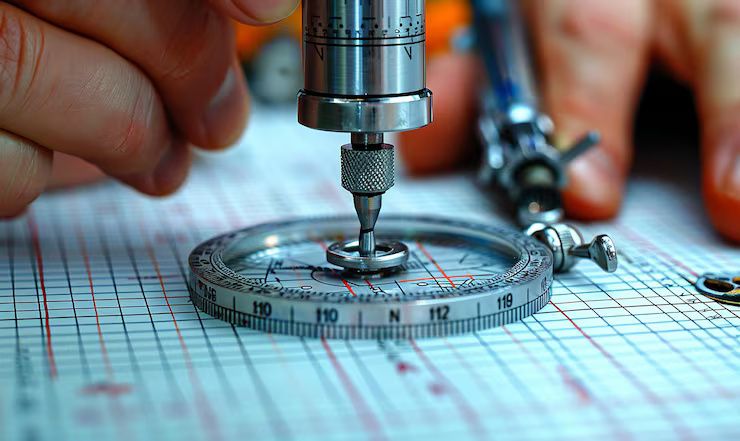
Ellipsometry systems are optical measurement platforms used to characterize thin films and surfaces by analyzing changes in polarized light after reflection from a material. The technique is widely used in semiconductor manufacturing, optics, display technology, solar cells, coatings, nanotechnology, and materials research.
Modern thin-film metrology systems can measure film thickness and provide information about optical properties such as refractive index and extinction coefficient. Advanced ellipsometry systems combine light sources, polarization components, detectors, sample stages, and software-based optical modeling to analyze materials at very small scales.
Context
What Is Ellipsometry?
Ellipsometry is a non-destructive optical characterization technique based on measuring the change in polarization when light interacts with a sample.
The measured response is commonly described using two parameters, Psi (Ψ) and Delta (Δ). These parameters are compared with an optical model of the sample to estimate characteristics such as film thickness and optical constants.
Ellipsometry does not simply measure reflected light intensity. Instead, it examines how the polarization state changes, allowing detailed information about thin-film structures to be extracted.
How Ellipsometry Systems Work
A typical ellipsometry system directs polarized light toward a sample at a controlled angle. Reflected light passes through polarization optics before reaching a detector.
The measurement software compares the observed polarization response with theoretical models. By fitting the measured data, the system can estimate parameters associated with one or more layers.
A simplified measurement sequence is:
- A light source generates controlled illumination.
- Polarization optics prepare the incident beam.
- Light interacts with the sample surface.
- Reflected light undergoes polarization changes.
- A detector records the optical response.
- Software analyzes Ψ and Δ.
- An optical model is fitted to the measured data.
- Film and material parameters are calculated.
Thin-Film Metrology
Thin-film metrology involves measuring the physical and optical properties of very thin material layers.
Ellipsometry can characterize films ranging from nanometer-scale layers to thicker structures, depending on the instrument configuration, material system, wavelength range, and optical model.
Applications include measurement of:
- Dielectric layers
- Oxide films
- Semiconductor layers
- Polymer coatings
- Transparent conductive films
- Organic materials
- Multilayer optical structures
Major Ellipsometry System Types
| System Type | Main Characteristic | Typical Applications |
|---|---|---|
| Spectroscopic Ellipsometer | Multiple wavelengths | Semiconductor and thin-film analysis |
| Single-Wavelength Ellipsometer | Fixed wavelength | Routine film measurements |
| Variable-Angle Ellipsometer | Multiple incident angles | Advanced material characterization |
| Imaging Ellipsometer | Spatially resolved measurements | Surface mapping |
| Mueller Matrix Ellipsometer | Full polarization information | Complex anisotropic materials |
| In-Situ Ellipsometer | Measurement during processing | Thin-film deposition |
| Ex-Situ Ellipsometer | Measurement outside process equipment | Laboratory and quality analysis |
Importance
Why Ellipsometry Systems Matter
Thin films can have a major influence on the electrical, optical, chemical, and mechanical behavior of manufactured components. Measuring these layers accurately is therefore important for research, process development, and manufacturing control.
Because ellipsometry analyzes polarization rather than relying only on intensity measurements, it can provide detailed information about thin-film optical behavior.
Optical Characterization Technologies
Ellipsometry belongs to a wider group of optical characterization technologies. These include reflectometry, spectrophotometry, interferometry, Raman spectroscopy, and other light-based measurement techniques.
The appropriate method depends on the material, thickness range, optical properties, surface structure, and measurement objective.
Refractive Index and Extinction Coefficient
A major application of spectroscopic ellipsometry is determining optical constants.
The refractive index (n) describes how light propagates through a material, while the extinction coefficient (k) relates to optical absorption.
Accurate n and k data can be useful when designing optical coatings, semiconductor structures, display components, and photonic devices.
Multilayer Film Analysis
Modern manufacturing frequently involves multilayer structures. Several thin films may be deposited sequentially on a substrate, with each layer having different optical properties.
Ellipsometry software can use multilayer optical models to estimate thickness and material parameters for individual layers.
Non-Destructive Measurement
Ellipsometry is generally considered non-destructive because it uses light rather than physically removing or cutting the sample.
This characteristic allows a sample to potentially undergo additional measurements or processing after characterization.
Industrial Applications
Semiconductor Manufacturing
Semiconductor manufacturing is a major application area for thin-film metrology. Modern integrated circuits contain numerous layers with tightly controlled dimensions and material properties.
Ellipsometry can be used to characterize dielectric films, photoresist layers, oxide structures, and other thin-film materials during process development and manufacturing.
Photovoltaic Manufacturing
Solar-cell structures contain multiple material layers that influence optical absorption and device performance.
Ellipsometry can characterize semiconductor films, transparent layers, passivation coatings, and other structures used in photovoltaic research and manufacturing.
Display Manufacturing
Display technologies such as OLED, LCD, and other advanced display architectures use thin films with carefully controlled optical and electrical properties.
Optical characterization can help evaluate film thickness, refractive index, and layer uniformity.
Optical Coatings
Lenses, mirrors, filters, and other optical components may use multilayer coatings to control reflection and transmission.
Ellipsometry can characterize coating thickness and optical constants during research and process development.
Advanced Materials
Researchers use ellipsometry to study polymers, nanomaterials, two-dimensional materials, semiconductors, and other advanced material systems.
Measurements can help investigate how optical properties change with thickness, composition, processing conditions, or environmental exposure.
Data Storage and Electronics
Thin-film structures are used in various electronic and data-storage technologies. Ellipsometric measurements can support material development and process characterization.
Biosensing and Biointerfaces
Ellipsometry can also be applied to biological interfaces and molecular layers. Changes in optical response can provide information about adsorption or film formation on surfaces.
Specialized configurations may be used for liquid environments and real-time measurements.
Recent Updates
Spectroscopic Measurement
Spectroscopic ellipsometers measure polarization changes over a range of wavelengths rather than at only one wavelength.
Broad spectral information can improve the ability to distinguish between material layers with different optical responses.
Imaging Ellipsometry
Imaging systems combine ellipsometric measurement with spatial information. This allows researchers to examine variation across a sample rather than obtaining only a single-point measurement.
Such measurements can be useful for evaluating film uniformity and identifying localized variations.
Automated Mapping
Automated sample stages can move wafers or substrates across multiple measurement points.
The resulting map can show changes in film thickness or optical parameters across the surface, supporting process-development and manufacturing analysis.
In-Situ and Real-Time Monitoring
In-situ ellipsometry systems can measure films while deposition or another processing step is taking place.
Real-time optical data can provide information about film growth and changes in optical properties without removing the sample from the processing environment.
Advanced Optical Modeling
Modern software can incorporate complex optical models for multilayer, anisotropic, rough, graded, or absorbing materials.
Model selection is important because an incorrect optical model can produce misleading parameter estimates even when the measured data are accurate.
Machine Learning and Automated Analysis
Data-driven methods are being investigated for automated spectral interpretation, model selection, anomaly detection, and process monitoring.
These techniques can complement traditional physical optical models, particularly when large datasets are available.
Manufacturing Equipment and System Components
Light Sources
Ellipsometers may use broadband lamps, lasers, LEDs, or other controlled optical sources depending on the measurement configuration.
The wavelength range affects which materials and optical transitions can be studied.
Polarization Components
Polarizers, compensators, retarders, and related optical components control and analyze the polarization state of light.
Their arrangement varies according to the ellipsometer architecture.
Sample Stages
Sample stages position wafers, substrates, or smaller specimens at defined locations and angles.
Automated stages can support measurement mapping and repeatable sample positioning.
Detectors
Optical detectors measure the reflected signal after interaction with the sample. Detector selection depends on the wavelength range and required sensitivity.
Analysis Software
Software is a central part of modern ellipsometry systems. It processes measured polarization data and applies optical models to estimate film parameters.
Users can compare measured and calculated spectra and evaluate model quality before accepting the resulting parameters.
Laws or Policies
Semiconductor and Manufacturing Quality Requirements
Industrial laboratories and manufacturing facilities generally establish measurement procedures, calibration practices, equipment qualification requirements, and data-management controls.
The exact requirements depend on the application and regulatory environment.
Laboratory Measurement Practices
Reliable ellipsometry requires appropriate instrument calibration, reference measurements, sample handling, and optical alignment.
Environmental conditions such as temperature, vibration, and contamination can also influence sensitive optical measurements.
Data Integrity
Automated metrology systems generate electronic measurement records. In regulated or quality-controlled environments, organizations may need procedures governing data access, traceability, retention, and modification.
Workplace and Laser Safety
Some ellipsometry systems use laser sources or other intense optical radiation. Appropriate safety controls depend on the instrument design and wavelength.
Facilities should follow applicable workplace, electrical, and optical-radiation safety requirements.
Tools and Resources
Optical Modeling Software
Optical modeling software is used to create representations of substrates and thin-film stacks. Users can define layer thicknesses, optical constants, surface properties, and other parameters.
Reference Materials
Reference samples and certified standards can help laboratories evaluate measurement repeatability and instrument performance.
Surface Characterization Tools
Ellipsometry is often combined with complementary techniques such as atomic force microscopy, X-ray photoelectron spectroscopy, profilometry, reflectometry, and electron microscopy.
Using multiple techniques can provide additional information when a single measurement method cannot fully characterize a complex structure.
Automated Metrology Platforms
Automated platforms can combine sample handling, measurement mapping, data processing, and statistical analysis.
Such systems are particularly relevant to high-volume semiconductor and thin-film manufacturing environments.
FAQs
What are ellipsometry systems?
Ellipsometry systems are optical measurement instruments that analyze changes in polarized light reflected from a sample. They are used to characterize thin-film thickness and optical properties.
What can ellipsometry measure?
Depending on the system and optical model, ellipsometry can estimate film thickness, refractive index, extinction coefficient, surface characteristics, and other optical parameters.
Why is ellipsometry used for thin-film metrology?
Ellipsometry can provide sensitive measurements of thin layers without physically removing material. Spectroscopic measurements can also provide information across a range of wavelengths.
What industries use ellipsometry systems?
Major application areas include semiconductor manufacturing, photovoltaics, display technology, optical coatings, advanced materials, electronics, nanotechnology, and biotechnology research.
What is spectroscopic ellipsometry?
Spectroscopic ellipsometry measures changes in polarization across multiple wavelengths. The resulting spectral data can be modeled to characterize material and thin-film properties.
Conclusion
Ellipsometry systems provide a powerful optical approach for thin-film metrology and material characterization. By measuring changes in polarized light, these systems can provide information about film thickness, refractive index, extinction coefficient, multilayer structures, and other optical properties.
Modern platforms increasingly combine spectroscopic measurement, automated mapping, imaging, in-situ monitoring, advanced optical modeling, and digital analysis. These capabilities make ellipsometry relevant to semiconductor manufacturing, photovoltaic technology, displays, optical coatings, advanced materials, and other industries where precise thin-film characterization is important.