Industrial 3D printing is an additive manufacturing approach in which components are produced by building material layer by layer from a digital design. Unlike conventional subtractive machining, which removes material from a larger workpiece, additive manufacturing creates geometry progressively according to programmed instructions.
Industrial 3D printing is used for prototyping, tooling, customized components, production parts, aerospace structures, medical devices, automotive components, and other engineered products. The technology can work with polymers, metals, ceramics, composites, and specialized materials depending on the printing process.
Context
What Is Industrial 3D Printing?
Industrial 3D printing refers to additive manufacturing systems designed for professional engineering, production, research, and industrial applications. These systems generally provide controlled material deposition, melting, curing, sintering, or bonding according to a digital model.
A typical workflow begins with a three-dimensional CAD model. Specialized software converts the model into machine instructions, after which the printer builds the component layer by layer.
How Additive Manufacturing Works
A general industrial 3D printing workflow includes:
- Creation of a digital CAD model
- Design preparation and geometry optimization
- Selection of material and printing technology
- Slicing the model into layers
- Machine setup and material preparation
- Layer-by-layer production
- Removal of supports or excess material
- Post-processing
- Dimensional and quality inspection
The exact sequence varies according to the printing technology and material.
Major Additive Manufacturing Technologies
| Technology | Material Form | Typical Applications |
|---|---|---|
| FDM/FFF | Thermoplastic filament | Prototypes, tooling, fixtures |
| SLA | Photopolymer resin | Detailed prototypes and models |
| SLS | Polymer powder | Functional components |
| SLM/DMLS | Metal powder | Metal production parts |
| Binder Jetting | Powder and binder | Metal and ceramic components |
| Material Jetting | Liquid photopolymer | Detailed prototypes |
| Electron Beam Melting | Metal powder | Selected metal components |
| Directed Energy Deposition | Metal wire or powder | Repair and large structures |
Fused Deposition Modeling
FDM, also called fused filament fabrication, uses thermoplastic filament that is heated and deposited through a nozzle.
Industrial FDM systems can produce prototypes, fixtures, tooling, housings, and selected production components. Material choices may include engineering thermoplastics and reinforced polymers.
Selective Laser Sintering
SLS uses a laser to selectively fuse powdered polymer material. Because the surrounding powder can support many geometries, SLS can reduce the need for conventional support structures.
It is used for prototypes, functional polymer components, housings, and customized parts.
Metal Additive Manufacturing
Metal additive manufacturing uses energy sources such as lasers or electron beams to consolidate metal powder or wire.
Processes such as selective laser melting, direct metal laser sintering, electron beam melting, and directed energy deposition can produce metal components with complex geometries.
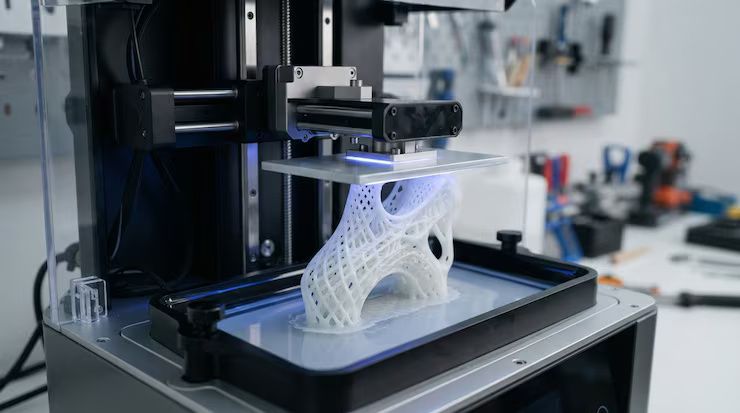
Stereolithography
Stereolithography uses light to selectively cure liquid photopolymer resin. It can produce components with fine details and smooth surfaces.
Industrial applications include visual prototypes, engineering models, casting patterns, and selected specialized components.
Importance
Why Industrial 3D Printing Matters
Industrial additive manufacturing can produce complex geometries that may be difficult to manufacture using conventional processes. It can also support rapid design iteration and production of customized components.
The technology does not replace conventional manufacturing in every application. Instead, it provides another production method that can be selected according to geometry, material, volume, precision, and performance requirements.
Rapid Prototyping
Engineers can create physical prototypes directly from digital designs. Design modifications can then be tested through successive production cycles.
This approach can shorten the transition between digital design and physical evaluation.
Complex Geometries
Additive manufacturing can create internal channels, lattice structures, lightweight forms, and other geometries that may require multiple conventional manufacturing steps.
Design-for-additive-manufacturing principles can help engineers take advantage of these capabilities.
Customized Components
3D printing can produce components adapted to specific dimensions or functional requirements.
This is particularly relevant to aerospace, healthcare, research, tooling, and specialized industrial equipment.
Material Efficiency
Because additive manufacturing generally places material where it is needed rather than removing large quantities from a solid block, some designs can use material more efficiently.
Actual material utilization depends on the printing process, support structures, failed parts, and post-processing requirements.
Production Systems
Industrial 3D Printers
Industrial printers include mechanical systems, motion platforms, material-delivery mechanisms, thermal controls, sensors, software, and process-monitoring equipment.
Machine architecture varies considerably between polymer, metal, ceramic, and composite printing technologies.
Build Chambers
Many industrial printers use controlled build environments. Temperature, humidity, atmosphere, or oxygen concentration may need to be regulated according to the material and process.
Metal powder systems can require controlled inert atmospheres to manage material behavior during production.
Material Handling
Industrial additive manufacturing can use filament, resin, powder, pellets, wire, or other feedstock forms.
Material storage and handling requirements vary according to moisture sensitivity, particle characteristics, chemical composition, and printing process.
Process Monitoring
Sensors and cameras can monitor parameters such as temperature, melt-pool behavior, layer formation, chamber conditions, and machine status.
Process monitoring can help identify deviations and generate production records.
Post-Processing Equipment
Printed components may require additional processing before use.
Examples include:
- Support removal
- Heat treatment
- Surface finishing
- Machining
- Polishing
- Washing
- Curing
- Powder removal
- Dimensional inspection
The required steps depend on the material and manufacturing technology.
Materials
Polymer Materials
Industrial polymer printing can use materials such as ABS, nylon, polycarbonate, PEEK, PEKK, polypropylene, and specialized engineering polymers.
Material selection depends on temperature resistance, strength, flexibility, chemical exposure, dimensional stability, and application requirements.
Metal Materials
Metal additive manufacturing can process materials such as stainless steel, aluminum alloys, titanium alloys, nickel alloys, tool steels, and cobalt-chrome alloys.
Each material has specific powder characteristics, thermal behavior, processing parameters, and post-processing requirements.
Ceramic Materials
Ceramic additive manufacturing can produce specialized geometries using ceramic powders or slurries.
Potential applications include technical components, laboratory structures, thermal-management parts, and specialized engineering applications.
Composite Materials
Composite additive manufacturing combines polymers with reinforcing materials such as carbon fiber or glass fiber.
These materials can provide different mechanical characteristics from conventional unreinforced polymers.
Manufacturers and Suppliers
The industrial 3D printing ecosystem includes manufacturers of printers, material systems, software, scanning equipment, post-processing systems, and inspection technologies.
When evaluating manufacturers and suppliers, organizations can examine:
- Printing technology
- Build volume
- Material compatibility
- Layer resolution
- Production throughput
- Process monitoring
- Software capabilities
- Automation features
- Post-processing requirements
- Quality documentation
- Equipment integration
For industrial production, printer specifications should be evaluated alongside material qualification, process repeatability, inspection requirements, and the intended application.
Industrial Applications
Aerospace Manufacturing
Aerospace organizations use additive manufacturing for prototypes, tooling, lightweight structures, ducts, brackets, and selected production components.
Complex geometries and weight-reduction opportunities can be particularly relevant to aerospace engineering.
Automotive Production
Automotive applications include prototypes, tooling, fixtures, interior components, customized parts, and selected functional components.
Additive manufacturing can support rapid design changes during vehicle development.
Medical Manufacturing
3D printing can produce anatomical models, surgical planning models, customized devices, dental components, and selected implant-related products.
Medical applications require appropriate material controls, manufacturing validation, and regulatory compliance.
Industrial Tooling
Manufacturers can use additive manufacturing to produce jigs, fixtures, assembly aids, molds, and specialized tooling.
Customized tooling can be produced according to specific production-line requirements.
Energy Industry
Energy applications can include prototypes, heat-management components, specialized tooling, and selected replacement components.
Metal additive manufacturing is also being investigated for complex geometries used in energy equipment.
Electronics
Additive manufacturing can support enclosures, fixtures, prototypes, thermal-management structures, and selected components used during electronics development.
Specialized printing methods are also being researched for conductive materials and electronic structures.
Recent Updates
Metal 3D Printing
Metal additive manufacturing continues to develop through improvements in laser systems, powder handling, process monitoring, and machine control.
New material combinations and larger build platforms are also expanding the range of potential applications.
Automated Production
Industrial 3D printing systems are increasingly being integrated with automated material handling, robotic part removal, inspection equipment, and production-management software.
Automation can help connect printing with downstream manufacturing processes.
AI and Machine Learning
AI-based systems can analyze process data to identify patterns and potential anomalies. Applications include parameter analysis, quality monitoring, defect detection, and process modeling.
AI outputs require appropriate validation before being incorporated into production decisions.
Digital Manufacturing
3D printing can connect directly with digital engineering workflows. CAD, simulation, slicing software, production monitoring, and inspection systems can create a connected manufacturing chain.
Digital records can also support traceability and process analysis.
Larger Build Volumes
Industrial printer manufacturers continue developing systems with larger build chambers and higher production capacity.
Larger platforms can accommodate bigger components or multiple parts within one build, although thermal management, distortion control, and process consistency become important engineering considerations.
Sustainable Manufacturing Research
Additive manufacturing is being investigated for applications where material efficiency, lightweight structures, localized production, or reduced tooling requirements may provide environmental advantages.
The actual environmental impact depends on material production, machine energy consumption, post-processing, part design, and overall production conditions.
Laws or Policies
Manufacturing Standards
Industrial additive manufacturing may be subject to standards covering material quality, machine operation, process control, inspection, and component qualification.
The applicable standards depend on the industry and intended use.
Aerospace Requirements
Aerospace components can require extensive qualification and documentation because component performance and manufacturing consistency are critical.
Specific requirements depend on the aircraft, component category, regulatory framework, and manufacturing organization.
Medical Regulations
Medical 3D printing applications may be subject to regulatory requirements covering materials, manufacturing processes, device safety, traceability, and quality management.
Organizations should identify applicable requirements before producing regulated medical components.
Workplace Safety
Industrial printers can involve heat, lasers, moving mechanisms, chemical materials, compressed gases, or fine powders.
Facilities should implement appropriate machine guarding, ventilation, personal protective equipment, material-handling procedures, and emergency controls according to the equipment and operating environment.
Powder Handling
Metal and polymer powders require appropriate storage, handling, ventilation, housekeeping, and waste-management procedures.
The specific requirements depend on material properties and applicable workplace regulations.
Tools and Resources
CAD Software
Computer-aided design software is used to create the digital geometry used by additive manufacturing systems.
Designers can incorporate additive-specific features such as lattice structures, internal channels, topology optimization, and lightweight geometries.
Slicing Software
Slicing software converts a three-dimensional model into layers and generates machine instructions.
Parameters can include layer height, build orientation, infill, laser settings, print speed, support structures, and other process variables.
Simulation Tools
Simulation can help evaluate thermal behavior, mechanical performance, distortion, residual stresses, and other characteristics before production.
3D Scanning
Three-dimensional scanners can capture physical geometry and compare manufactured components with digital models.
This can support dimensional inspection and reverse-engineering workflows.
Manufacturing Execution Systems
MES platforms can connect additive manufacturing equipment with production schedules, material records, machine data, quality information, and electronic production documentation.
FAQs
What is industrial 3D printing?
Industrial 3D printing is an additive manufacturing method that creates physical components layer by layer from digital designs using polymers, metals, ceramics, composites, or other materials.
What are the main industrial 3D printing technologies?
Common technologies include FDM, SLA, SLS, metal powder-bed fusion, electron beam melting, binder jetting, material jetting, and directed energy deposition.
What materials are used in industrial 3D printing?
Industrial systems can process engineering polymers, thermoplastics, photopolymer resins, metals, ceramics, and fiber-reinforced composites.
What industries use additive manufacturing?
Aerospace, automotive, healthcare, electronics, energy, industrial machinery, tooling, research, and specialized manufacturing sectors use additive manufacturing for various applications.
How do manufacturers evaluate industrial 3D printers?
Important factors include printing technology, build volume, material compatibility, resolution, production capacity, process monitoring, software integration, post-processing requirements, and quality documentation.
Conclusion
Industrial 3D printing has developed from a primarily prototyping-focused technology into a manufacturing approach used for tooling, customized components, complex structures, and selected production parts. Technologies such as polymer extrusion, stereolithography, selective laser sintering, metal powder-bed fusion, binder jetting, and directed energy deposition provide different capabilities.
Advances in process monitoring, AI-assisted analysis, automation, larger build systems, digital manufacturing, and specialized materials are continuing to expand additive manufacturing applications. Successful implementation requires careful consideration of material properties, design requirements, machine capabilities, post-processing, inspection, production volume, and applicable industry standards.