
Chemical fluid manufacturing involves producing liquid chemical mixtures for industrial, commercial, and technical applications. These fluids may include cleaning solutions, lubricants, coolants, water-treatment chemicals, process liquids, hydraulic fluids, and specialized formulations used in manufacturing facilities. Their composition depends on the intended application, required physical properties, chemical compatibility, and operating conditions.
The manufacturing process typically combines raw materials according to a defined formulation, followed by mixing, quality testing, and packaging or transfer into suitable containers. Some formulations require only straightforward blending, while others involve chemical reactions, temperature control, filtration, or specialized handling procedures.
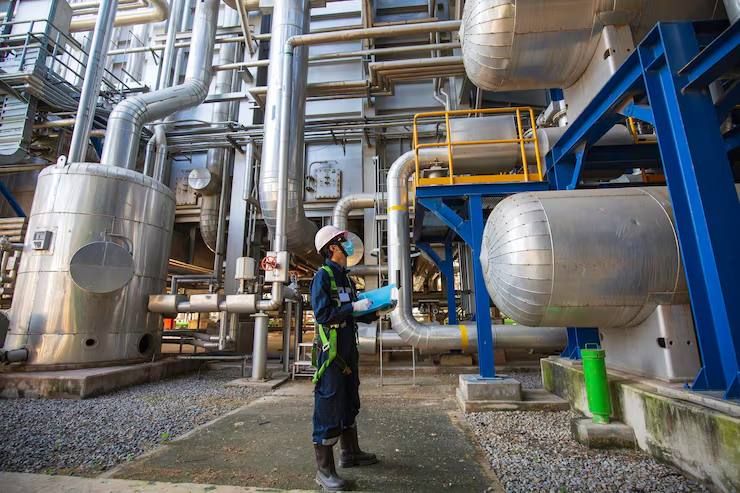
Chemical fluid manufacturing is closely connected to chemical engineering, materials science, process control, and industrial quality management. Manufacturers must understand how ingredients interact and how factors such as concentration, viscosity, pH, stability, and temperature influence the final product.
Main categories of industrial chemical fluids
Industrial chemical fluids serve different purposes depending on their composition and performance requirements.
Industrial lubricants: Reduce friction and wear between moving surfaces in machinery and equipment.
Hydraulic fluids: Transfer power in hydraulic systems while supporting lubrication and corrosion protection.
Industrial coolants: Remove heat from machines, production processes, and equipment.
Water-treatment chemicals: Support processes such as pH adjustment, scale control, coagulation, and disinfection.
Cleaning fluids: Remove oils, residues, particles, and other contaminants from industrial surfaces.
Metalworking fluids: Assist machining and forming operations through lubrication, cooling, and debris removal.
Process chemicals: Support specific manufacturing operations in sectors such as textiles, paper, electronics, and chemical processing.
Each category has distinct formulation requirements. A fluid intended for a closed hydraulic circuit, for example, may need different viscosity and material compatibility characteristics from a cleaning solution designed to remove contaminants from metal surfaces.
How chemical fluid formulations are developed
Formulation development begins with identifying the properties required for a particular application. Chemical engineers and formulation specialists consider the intended function, operating temperature, contact materials, environmental conditions, storage requirements, and relevant safety restrictions.
The formulation may contain a base liquid, active chemical ingredients, stabilizers, corrosion inhibitors, surfactants, or other additives. Not every formulation contains all these components. Their selection depends on the chemistry of the system and the properties required in the finished fluid.
Laboratory trials are often conducted before a formulation enters routine production. These trials help evaluate properties such as viscosity, density, acidity or alkalinity, phase stability, compatibility, and performance under representative conditions. Results are used to establish production specifications and quality-control procedures.
Importance of Chemical Fluid Manufacturing
Chemical fluids support many industrial operations that would otherwise experience greater friction, heat accumulation, contamination, corrosion, or process instability. Their composition can influence machinery performance, product quality, equipment maintenance, and the consistency of manufacturing activities.
Reliable fluid production is therefore important to industries that depend on controlled operating conditions. Inadequate mixing, incorrect concentrations, incompatible ingredients, or contamination can affect the intended function of a formulation.
Industrial problems addressed by chemical fluids
Chemical fluid formulations help manage several recurring manufacturing challenges.
Friction and wear: Lubricating fluids reduce direct contact between moving components under suitable operating conditions.
Heat removal: Coolants transfer heat away from equipment or production materials.
Corrosion control: Certain formulations help protect compatible metals from corrosive environments.
Surface contamination: Cleaning fluids remove residues that may interfere with manufacturing or inspection.
Water quality: Treatment chemicals help control selected physical, chemical, or biological conditions in water systems.
Process consistency: Formulated fluids help maintain defined operating conditions across repeated production cycles.
These functions depend on proper fluid selection, operating conditions, and maintenance. A formulation suitable for one machine or process may be unsuitable for another, even when the applications appear similar.
Industries that use manufactured chemical fluids
Chemical fluid manufacturing supports a broad range of sectors.
Automotive and transportation: Hydraulic fluids, lubricants, coolants, cleaning solutions, and metalworking fluids support vehicle production and maintenance operations.
Metal fabrication: Cutting fluids and forming lubricants help control heat, friction, and surface conditions during machining, stamping, and other metalworking processes.
Chemical and petrochemical processing: Process fluids support heat transfer, material handling, equipment operation, and specialized production stages.
Electronics manufacturing: Selected cleaning agents and process liquids are used where contamination control and material compatibility are important.
Food and beverage processing: Suitable cleaning and sanitation formulations support equipment hygiene, subject to applicable food-contact and safety requirements.
Water and wastewater treatment: Chemical formulations assist in controlling water chemistry and removing selected contaminants.
Textile and paper manufacturing: Specialized fluids support wet processing, surface treatment, cleaning, and other production activities.
The requirements for each industry differ. For example, chemical fluids used around sensitive electronic components may require strict control of residues, while fluids for heavy machinery may prioritize lubrication, thermal stability, and resistance to oxidation.
Chemical Fluid Formulation and Manufacturing Processes
Chemical fluid production involves several stages, from raw material inspection to final quality verification. The exact sequence depends on the formulation, batch size, chemical hazards, and required product specifications.
Main stages of chemical fluid production
1. Raw material selection and inspection
Manufacturers identify the required ingredients and verify their specifications before production. Incoming materials may be checked for identity, concentration, purity, moisture content, and other relevant properties. Appropriate storage conditions help prevent degradation, contamination, or unwanted reactions.
2. Formulation and batch planning
A formulation specifies the ingredients, their proportions, mixing sequence, and required processing conditions. Batch documentation identifies the quantities and production parameters needed to maintain consistency between manufacturing runs.
3. Blending and mixing
Ingredients are introduced into a mixing vessel according to the established procedure. Agitators, circulation systems, or specialized mixers help distribute components throughout the liquid. Mixing speed, duration, temperature, and addition sequence may affect uniformity and stability.
4. Temperature and process control
Some formulations require heating to improve solubility or mixing, while others need cooling to limit evaporation or prevent unwanted reactions. Temperature sensors, flow meters, and automated control systems help operators maintain the specified conditions.
5. Filtration and separation
Filtration removes unwanted particles when required by the formulation. Certain processes may also use settling, centrifugation, or other separation techniques to remove impurities or distinguish liquid phases.
6. Quality testing
Samples are tested against established specifications. Depending on the formulation, tests may examine viscosity, density, pH, concentration, appearance, contamination, stability, or functional performance.
7. Filling, labeling, and storage
Approved batches are transferred into compatible containers, drums, intermediate bulk containers, or dedicated tanks. Labels and production records identify the formulation, batch, handling precautions, and other required information.
Common blending technologies
Different equipment is selected according to fluid viscosity, ingredient compatibility, batch volume, and mixing requirements.
Equipment type | Primary function | Typical application |
|---|---|---|
Agitated mixing tanks | Blend liquid ingredients | Lubricants and process fluids |
High-shear mixers | Disperse difficult-to-mix ingredients | Emulsions and selected cleaning formulations |
Inline mixers | Mix fluids during continuous flow | Continuous chemical processing |
Metering pumps | Deliver controlled ingredient quantities | Concentrated additives and dosing systems |
Filtration systems | Remove specified particles | Process liquids and precision formulations |
Automated batching systems | Control ingredient addition and process sequences | Repeated industrial production |
Equipment compatibility is important. Materials that contact the fluid must withstand its chemical composition, temperature, and pressure. Seal materials, tank linings, pipework, and pumps also require appropriate selection.
Batch manufacturing versus continuous production
Batch manufacturing produces a defined quantity of fluid in a vessel before the next batch begins. It is useful for multiple formulations, specialized products, and production processes that require individual batch records.
Continuous manufacturing introduces ingredients and processes material through an ongoing flow. It can suit stable, high-volume formulations with well-established operating parameters. Both approaches require monitoring, process documentation, and quality controls appropriate to the product.
Recent Developments in Chemical Fluid Manufacturing
Developments across 2024–2026 have reflected wider industrial interest in automation, digital process monitoring, energy efficiency, and improved chemical handling. Adoption varies by manufacturer, formulation type, production scale, and regulatory requirements.
Automation and digital formulation control
Automated batching systems can measure ingredient quantities, control mixing sequences, record temperatures, and maintain production histories. These systems help reduce manual data entry and make it easier to investigate differences between batches.
Digital monitoring can also identify deviations from defined operating ranges. For example, a temperature or mixing-speed alert may prompt an operator to investigate a process before a batch moves to the next production stage. Automation does not eliminate the need for validated procedures, equipment maintenance, or human oversight.
Advanced formulations and material compatibility
Research and product development continue to examine formulations designed for particular operating environments, including high temperatures, demanding lubrication conditions, precision cleaning, and specialized cooling applications. Some manufacturers are also evaluating biodegradable ingredients or formulations with reduced environmental impact.
Such characteristics must be assessed in context. A formulation described as biodegradable, for instance, still requires evidence appropriate to its composition and disposal conditions. Environmental suitability cannot be determined from a single ingredient or product label alone.
Energy efficiency and waste reduction
Chemical fluid manufacturers are increasingly examining energy use in mixing, heating, cooling, pumping, and filtration. Process optimization may reduce unnecessary circulation, heating demand, material losses, and rejected batches.
Improved inventory tracking and controlled dispensing can also help reduce spills and expired raw materials. The actual environmental benefit depends on the production process, ingredient sourcing, equipment efficiency, and waste treatment arrangements.
Traceability and production data
Electronic batch records and laboratory data systems can connect raw materials, production parameters, test results, and finished batches. This supports investigations when a formulation fails to meet its specifications and helps manufacturers maintain consistent documentation.
Digital systems must also protect records against unauthorized changes, data loss, and access by people without appropriate permissions.
Laws and Policies Affecting Chemical Fluid Manufacturing
Chemical fluid production is subject to requirements related to chemical classification, workplace safety, storage, transport, labeling, pollution control, and waste management. The specific rules depend on the substances involved, their hazards, the manufacturing activity, and the country where the facility operates.
Regulatory considerations in India
In India, chemical fluid manufacturers may need to consider applicable provisions of the Environment (Protection) Act, 1986, the Water (Prevention and Control of Pollution) Act, 1974, and relevant rules governing hazardous chemicals and waste. Requirements may include pollution-control permissions, safe storage arrangements, emissions or effluent controls, and authorized waste handling, depending on the facility and its activities.
The Manufacture, Storage and Import of Hazardous Chemical Rules, 1989, address specified hazardous chemicals and associated safety requirements within their scope. Not every industrial fluid or formulation falls under the same classification, so the ingredients, concentrations, quantities, and process conditions must be evaluated.
Workplace requirements may also cover chemical exposure, personal protective equipment, emergency planning, training, and safe handling procedures. Manufacturers should verify the current applicable legislation and state-level requirements with the relevant authorities.
Chemical labeling and safety documentation
Safety data sheets communicate information about chemical hazards, safe handling, storage, exposure controls, and emergency measures. Labels identify relevant hazards and precautions according to the applicable classification and labeling requirements.
Manufacturers should maintain suitable documentation for raw materials and finished formulations. This includes accurate ingredient information where required, hazard assessments, batch records, and procedures for spills or accidental exposure.
Quality and environmental management standards
Several international standards and frameworks may support chemical fluid manufacturing:
ISO 9001: Quality management and process consistency.
ISO 14001: Environmental management and control of environmental impacts.
ISO 45001: Occupational health and safety management.
Globally Harmonized System (GHS): A framework for classifying and communicating chemical hazards, implemented through national or regional rules.
These frameworks have different legal statuses across jurisdictions. Certification or use of a standard does not replace compliance with applicable legislation.
Tools and Resources for Chemical Fluid Manufacturing
Manufacturers use engineering tools, laboratory instruments, and production software to maintain formulation accuracy and monitor manufacturing conditions.
Common tools and platforms
Laboratory testing instruments: Viscometers, pH meters, density meters, titration equipment, and analytical instruments help evaluate fluid properties and ingredient concentrations.
Process control systems: Programmable logic controllers and supervisory control systems monitor mixing equipment, temperature, pressure, fluid levels, and dosing operations.
Formulation management software: These systems maintain ingredient specifications, formulation versions, batch instructions, and production records.
Laboratory information management systems (LIMS): LIMS platforms organize sample identification, test results, laboratory workflows, and quality records.
Environmental monitoring equipment: Suitable sensors and analytical methods help monitor wastewater characteristics, chemical emissions, and other relevant environmental parameters.
Information required before production
A manufacturing plan typically defines the formulation, raw material specifications, mixing sequence, operating limits, quality tests, packaging requirements, and safety precautions. Documented procedures help operators follow the same approved process across batches.
Production planning should also account for chemical compatibility, ventilation, spill containment, equipment cleaning, and appropriate waste management. These controls are particularly important when formulations contain corrosive, flammable, reactive, or environmentally hazardous substances.
Frequently Asked Questions
What is chemical fluid manufacturing?
Chemical fluid manufacturing is the production of liquid chemical formulations through controlled blending, mixing, processing, and quality testing. It supports applications such as lubrication, cooling, cleaning, water treatment, and industrial processing.
What equipment is used for chemical fluid blending?
Common equipment includes mixing tanks, agitators, high-shear mixers, metering pumps, filtration systems, and automated batching controls. The selection depends on viscosity, formulation chemistry, production volume, and required mixing performance.
How is quality maintained in chemical fluid production?
Quality is maintained through raw material inspection, controlled ingredient quantities, documented processing conditions, representative sampling, and testing against defined specifications. Batch traceability helps identify and investigate deviations.
Which industries use industrial chemical fluids?
Automotive manufacturing, metalworking, chemical processing, electronics production, water treatment, food processing, and textile manufacturing all use specialized chemical fluids. Formulations differ according to the process and applicable safety requirements.
What regulations apply to chemical fluid manufacturing in India?
Applicable requirements may cover hazardous chemical handling, environmental protection, workplace safety, labeling, storage, and waste management. The specific obligations depend on the formulation, quantities handled, manufacturing process, and location.
Conclusion
Chemical fluid manufacturing combines formulation science, controlled blending, process engineering, and laboratory testing to produce liquids for diverse industrial applications. Product consistency depends on suitable ingredients, compatible equipment, accurate process control, and reliable quality verification. Automation and digital recordkeeping are increasingly used to support traceability and production monitoring. Chemical safety, environmental management, and applicable regulatory requirements remain essential parts of the manufacturing process.